Undo
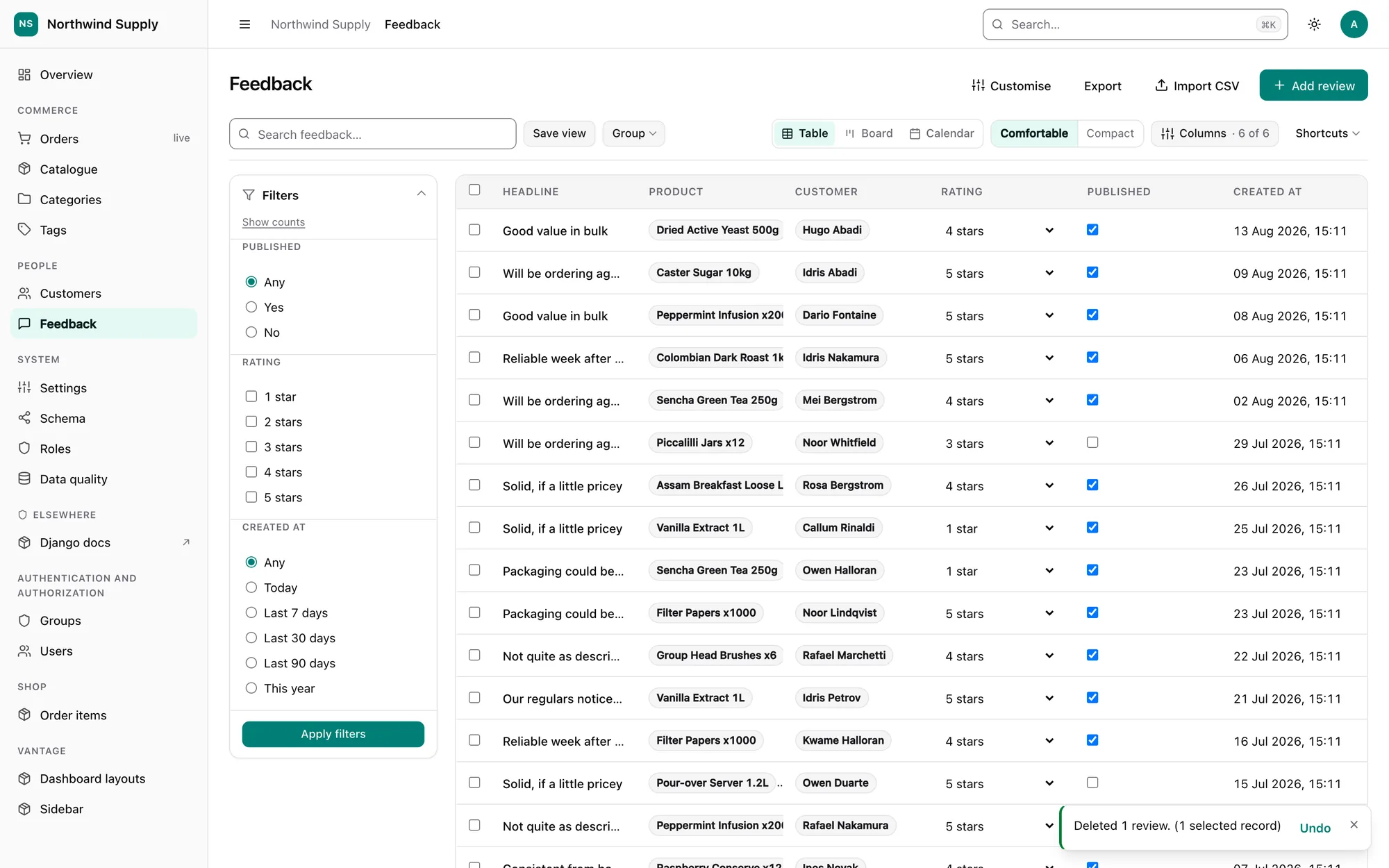
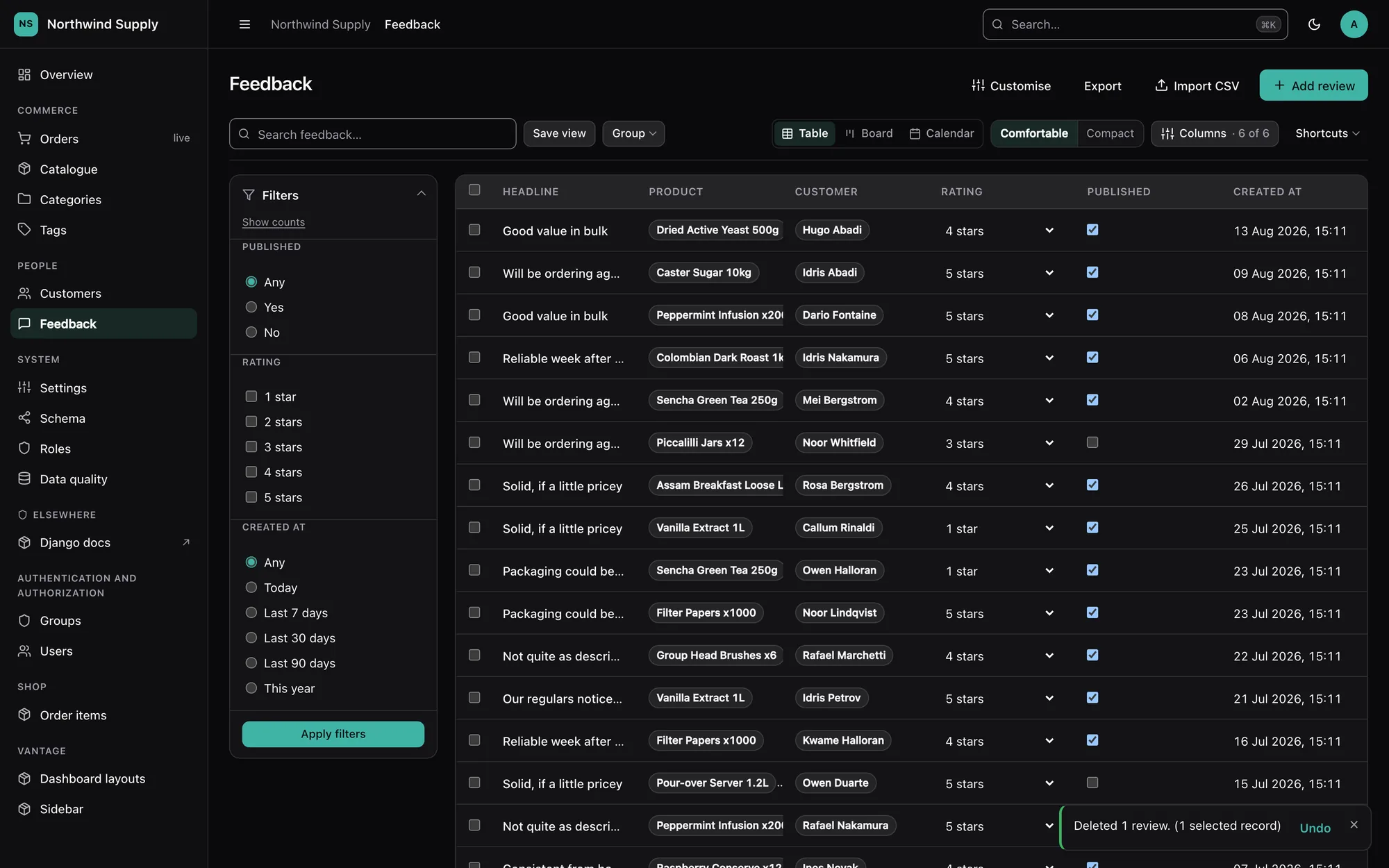
After a delete or an edit, the confirmation toast carries an Undo button:
Deleted 3 orders. (3 selected records) · Undo
It stays for VANTAGE["UNDO_WINDOW"] seconds (10 by default), and pressing it — or
Ctrl/⌘+Z while you are not typing in a field — puts the
records back. There is nothing to configure: every panel gets it.
VANTAGE = {
    "UNDO_WINDOW": 10,      # seconds; 0 turns undo off everywhere
    "UNDO_MAX_ROWS": 1000,  # larger changes still happen, without an Undo
}

@register(Payout)
class PayoutPanel(ModelPanel):
    undo = False            # this model's deletes and edits are final
The feature exists to stop data being lost, so it is built around one rule: an undo that might restore the wrong thing is never offered. In those cases the change happens exactly as it always did and the toast simply has no button. Everything below is what that rule means in practice.
What can be undone
| Change | How it is reversed |
|---|---|
| Delete (record page) | Soft delete: un-trashed. Hard delete: snapshot and restore |
Delete (bulk, actions = ["delete_selected"]) |
The same, for every selected row |
| Bulk edit | Each row's previous values are written back |
| Inline cell edit | The same, and the grid updates in place without a reload |
| Publish / Unpublish (built-in) | The flag goes back to what it was, row by row |
Your own @action |
Only if it declares how — see below |
delete_selected is the bulk counterpart of the Delete page, and opt-in:
On a model with a trash it trashes, exactly like the per-record button; inside the
trash it deletes for good. It needs the delete permission, confirms first, and one
PROTECT reference anywhere in the selection leaves every row as it was.
Edits: only if nobody has touched it since
An edit records each row's values before and after, read back from the database inside the transaction that wrote them. Undo writes the "before" back only if every row still holds exactly the "after" — checked under a row lock. If a colleague has changed one of those fields since, nothing is reverted at all, and the toast says so:
1 record has been changed by someone else since, so nothing was undone. Their change has been kept.
All or nothing, deliberately. Reverting nine rows and skipping the tenth leaves a state nobody chose; reverting the tenth would destroy someone else's work. The undo also advances the optimistic-lock version column, so an edit form somebody has open on the old values conflicts rather than quietly writing them back.
An edit is not offered for undo when it touches a field whose value cannot be compared and restored faithfully — a file, a JSON field, a binary field or a many-to-many.
Soft deletes: already reversible
When the model has a trash (a deleted_at timestamp or an is_deleted flag — see
Inference), Delete marks the row and Undo unmarks it, on the condition
that the mark is still the one this delete wrote.
Hard deletes: snapshot and restore
The delete runs immediately, as it always has, inside one transaction that first records
every row the cascade is about to remove — and the old value of every foreign key that
SET_NULL or SET_DEFAULT will rewrite. Undo re-inserts those rows with their original
primary keys, many-to-many rows included, and points those foreign keys back.
Why not "deferred delete"?
The other common design keeps the rows, hides them, and deletes them when the window closes. It was rejected:
- Hiding only works inside the admin. Your site, your API, your workers and your reports would keep reading — and writing — records the user was told were gone.
- Somebody has to run the delete later. With several worker processes and no guaranteed scheduler, a deletion can run late or never. For a record deleted for privacy reasons, never is the failure that matters.
- The delete would run against data that has moved. A new
PROTECTreference makes it fail after the user was told it succeeded; a newCASCADEchild is destroyed without ever having been shown on the confirmation page.
When a hard delete has no Undo
Snapshot and restore has risks of its own. Each is a case where the delete proceeds normally and no Undo is offered:
| Condition | Why |
|---|---|
A pre_delete/post_delete receiver on any model in the cascade |
It may have deleted a file, revoked a key or called an external service. Re-inserting the row cannot reverse that, and would resurrect a record pointing at things that no longer exist |
A database-level on_delete (DB_CASCADE, DB_SET_NULL…) touching the cascade |
The database rewrites rows the snapshot never saw |
The model overrides delete(), or its default queryset overrides QuerySet.delete() |
Your own delete has to run, and it cannot be snapshotted from outside |
More than UNDO_MAX_ROWS rows, cascade and rewritten references included |
The snapshot itself would be the problem |
| A binary column in the cascade | Not snapshotted |
Restoring is just as careful. Rows are inserted with force_insert, so a primary key or
a unique value somebody has taken in the meantime is an error, never an overwrite; a
SET_NULL reference somebody has since pointed elsewhere is a conflict; foreign-key
integrity is checked before commit. Any failure rolls the whole restore back and says
that nothing was changed.
Restored rows are saved with raw=True, exactly as loaddata saves fixtures, so
pre_save/post_save receivers see them — check raw if a receiver should ignore them.
The token
Each Undo carries a random token that is:
- single-use — consumed by a conditional
UPDATEbefore anything is restored, so a double click undoes once and both clicks get the same answer; - bound to the user and to the browser session that made the change;
- short-lived — it expires with the window, and the server enforces that whatever the page shows;
- as privileged as the change — undoing a delete needs
delete, undoing an edit needschange, re-checked at the moment of the undo, and refused in read-only mode; - redeemed only by a CSRF-protected POST to
<site>/_/undo/; - audit-logged — a successful undo writes "undid delete of 3 orders" to the audit log.
Only a hash of the token is stored. Entries live in the vantage_undoentry table;
expired ones are purged whenever a new one is written, each user keeps at most twenty,
and a redeemed entry drops its snapshot immediately. A hard delete's snapshot is a copy
of deleted data, so if you need a firm bound on how long it can outlive its window, run
manage.py vantage_purge_undo from cron.
Undo for your own actions
An action is arbitrary code, so its inverse is never guessed. Say which fields it writes and Vantage records and restores them, with the same conflict check as an edit:
@action("Mark as paid", bulk_strategy="sql", undo_fields=["status"])
def mark_paid(self, request, queryset):
    return f"{queryset.update(status='paid')} orders marked paid."
For anything undo_fields cannot express, return the state you will need and name a
hook. The hook runs inside a transaction; raise UndoConflict to refuse, and everything
it did is rolled back:
from vantage.actions import ActionResult
from vantage.undo import UndoConflict

@action("Refund", undo="undo_refund")
def refund(self, request, queryset):
    ids = list(queryset.values_list("pk", flat=True))
    queryset.update(status="refunded")
    return ActionResult(f"Refunded {len(ids)}.", undo_state={"ids": ids})

def undo_refund(self, request, state):
    rows = Order.objects.filter(pk__in=state["ids"], status="refunded")
    if rows.count() != len(state["ids"]):
        raise UndoConflict("Some of these orders have moved on since the refund.")
    rows.update(status="paid")
Actions large enough to run as a background job never offer undo: there is no toast to put the button in.
Accessibility and no-JavaScript
The toast region is a role="status" live region, so the message and its button are
announced. The Undo button is an ordinary focusable <button>, it declares its shortcut
with aria-keyshortcuts, and the shortcut follows the same on/off switch as the grid's
keyboard shortcuts. The toast does not steal focus. Its entrance animation is dropped
under prefers-reduced-motion.
Without JavaScript the button is never shown, and every change behaves exactly as it did before undo existed: a button that could outlive its own window would be a promise the page cannot keep.