Data quality
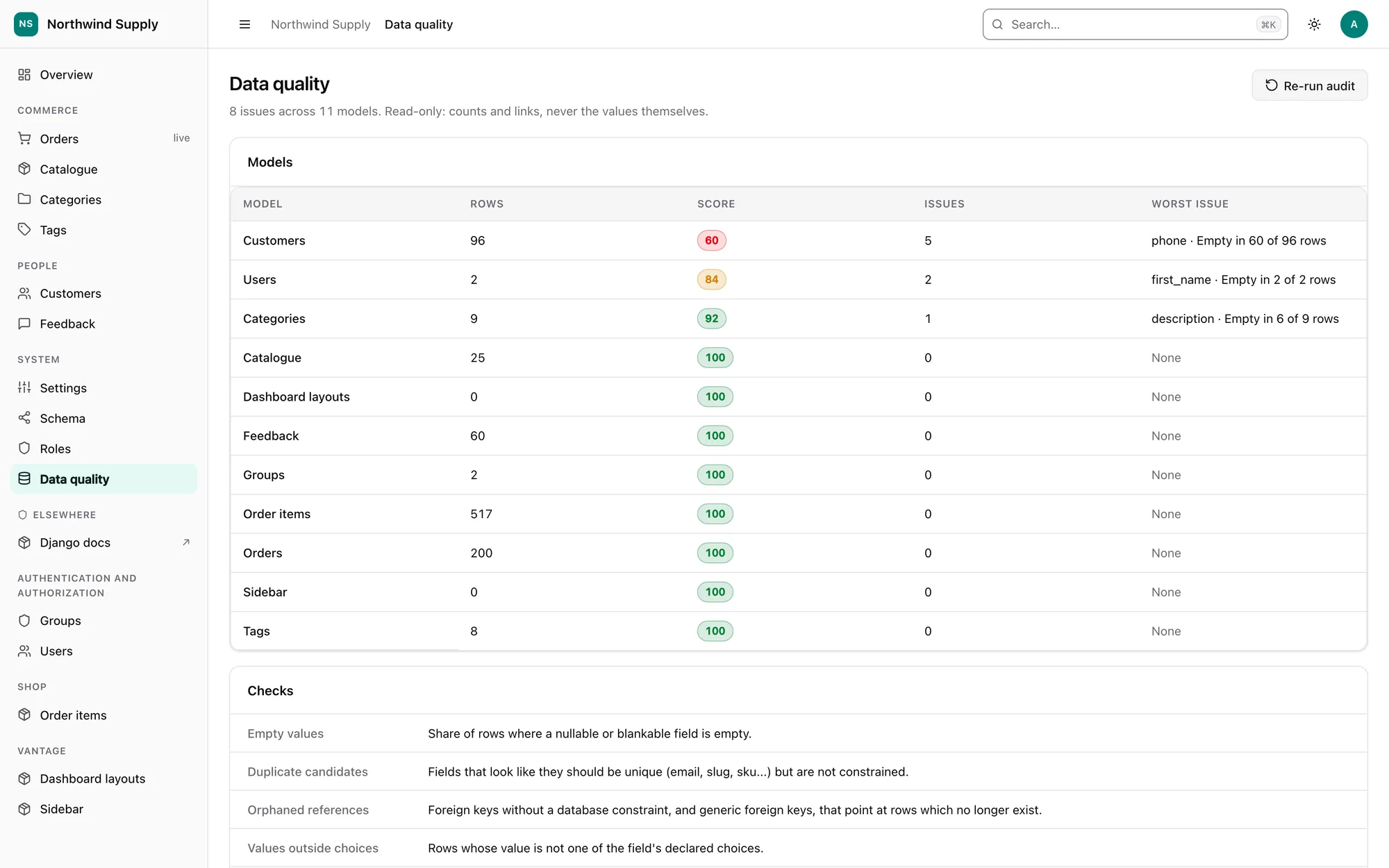
A read-only health check of the rows in every registered model, at
/_/data-quality/ under the System group, and as manage.py vantage_data_quality.
System answers "is the deployment sound?". This answers the question that comes a
month later: is the data any good?
What it checks
| Check | Finds | Links to the list page? |
|---|---|---|
nulls |
Share of rows where a nullable or blank field is empty | Yes, for nullable non-text fields the list filters on |
duplicates |
Fields named like identifiers (email, slug, sku, code, username...) that are not unique-constrained but hold repeated values (case-insensitive) |
No |
orphans |
Foreign keys with db_constraint=False and generic foreign keys that point at a missing row or a missing content type |
No |
choices |
Values outside the field's declared choices |
No |
dates |
Created-like timestamps in the future (more than a day of clock skew) and any date before 1900 | Yes, as a date window |
empty |
A model with no rows | n/a |
stale |
A last-modified field (auto_now, updated_at, modified...) older than STALE_DAYS |
Yes, as a date window |
A link is only offered when the list page can express exactly the offending rows: the
panel must filter on that field (list_filter, or inferred) and the real filter must
accept the value. Otherwise the finding has no link rather than a wrong one.
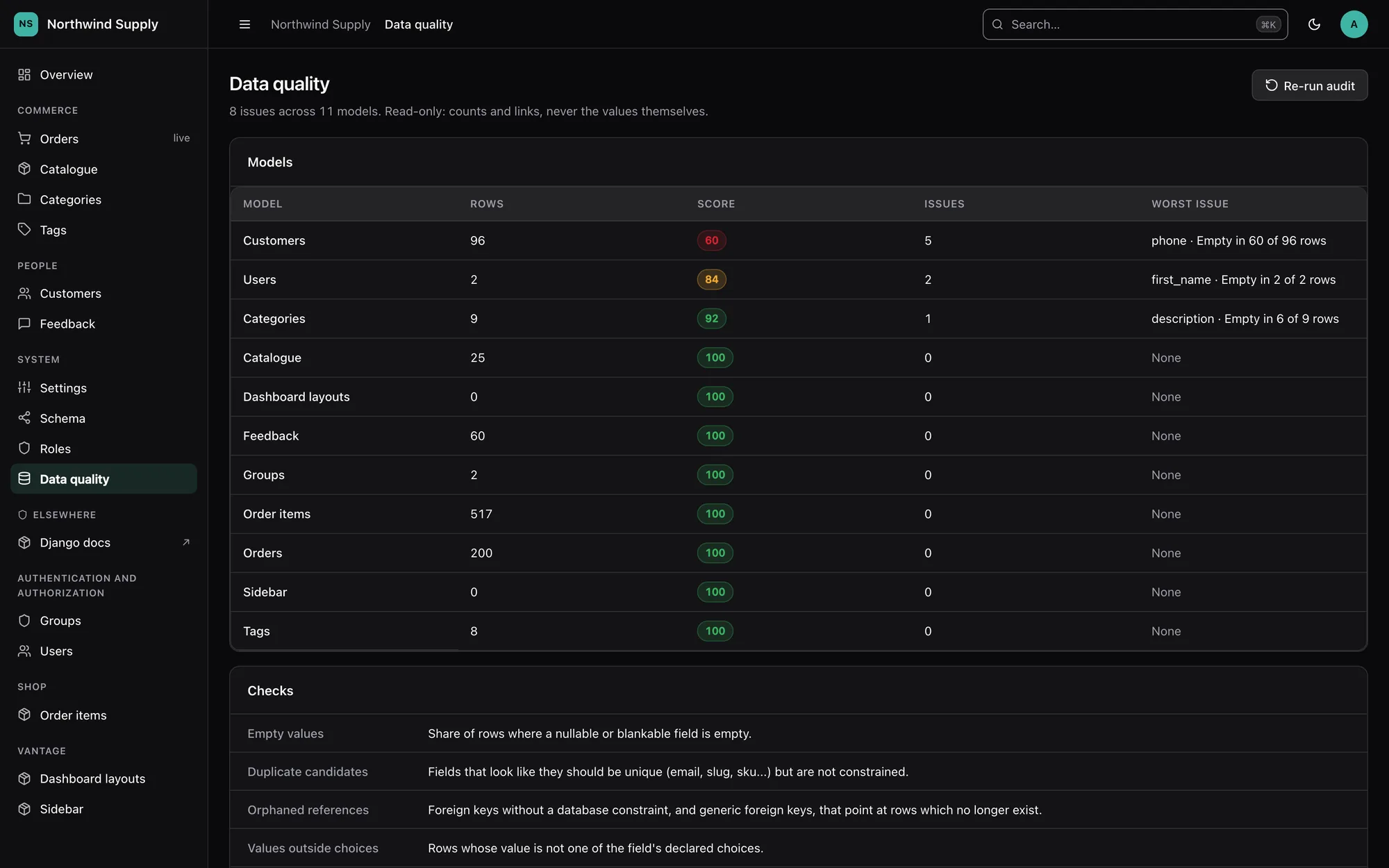
The overview lists every model with its row count, a 0-100 score and its worst issue; click a model for field-level findings and how each check went. The score is 100 minus 25 per failure (an orphaned reference) and 8 per warning, per finding rather than per row. Notes (a nullable field that is mostly filled, an empty table) cost nothing.
It never shows a value
A finding is a count, a field name and a link. No cell from any row is ever read into the report, so the page cannot become a way around field masking. That holds for the page, the cache, the JSON output and the command.
It is bounded
- Above
SAMPLE_SIZErows, checks read the newest rows by primary key (one index lookup finds the cutoff). The report sayssampled, and findings say "in sample". - Above
SKIP_ABOVEestimated rows (PostgreSQL planner estimate; reuses the list page's~counts) the data checks are skipped and the row saysskipped. - Each check has
CHECK_TIME_BUDGETseconds, enforced between queries and, on PostgreSQL, as astatement_timeout. A check that runs out keeps what it found and is markedtimeout. - A render spends at most
PAGE_TIME_BUDGETseconds auditing. Models not reached shownot yet run; the Re-run button continues where it stopped. - Results are cached (
CACHE_SECONDS). The key hashes the scoped SQL and the thresholds, so a different user, tenant or setting never sees someone else's result.
Background jobs were considered and not used: vantage.jobs is built around a stored
action and selection, and an audit has neither. For a very large database run the
management command from cron or CI; it has no page budget and warms the same cache the
page reads.
Access
Superusers by default. Widen it with a permission string or a callable:
VANTAGE = {
    "DATA_QUALITY": {
        "PERMISSION": "myapp.view_data_quality",   # or lambda request: ...
    },
}
Whoever gets in still only sees models the permission resolver lets them view, through
the same queryset as the list page: the panel's get_queryset, the resolver's
filter_queryset and tenant scoping. A tenant-scoped user audits their tenant's rows.
Settings
All under VANTAGE["DATA_QUALITY"]; an unknown key is an error with a suggestion.
| Key | Default | Effect |
|---|---|---|
ENABLED |
True |
False hides the page and disables the command |
PERMISSION |
None |
None is superusers; a permission string or callable(request) |
CHECKS_EXCLUDE |
[] |
Check names skipped everywhere |
SAMPLE_SIZE |
50000 |
Rows read per model before sampling |
SKIP_ABOVE |
5000000 |
Estimated rows above which data checks are skipped |
CHECK_TIME_BUDGET |
3.0 |
Seconds per check per model |
PAGE_TIME_BUDGET |
12.0 |
Seconds a page render may spend auditing |
CACHE_SECONDS |
3600 |
How long a result is cached |
NULL_WARN_RATE |
0.5 |
Empty share above which a field is a warning |
STALE_DAYS |
365 |
Days without a change before a table is stale |
DUPLICATE_FIELDS |
[] |
Extra field names ("external_id" or "app.model.field") to treat as should-be-unique |
Opting a model out
One line on the panel:
class AuditLogPanel(ModelPanel):
    data_quality = False                 # leave it out entirely
    # data_quality = ["nulls", "stale"]  # or skip just these checks
An unknown check name is vantage.E063 in manage.py check.
Adding a check
from vantage.dataquality import Check, register_check

@register_check
class InvoicesHaveLines(Check):
    name = "invoice-lines"
    label = "Invoices without lines"

    def applies(self, panel):
        return panel.model._meta.label == "billing.Invoice"

    def run(self, ctx):
        # ctx.scan is the bounded queryset; ctx.tick() raises when the budget is spent.
        ctx.tick()
        count = ctx.scan.filter(lines__isnull=True).count()
        if count:
            yield ctx.finding(self.name, "warn", f"{count} invoices have no lines",
                              count=count, scanned=ctx.scanned)
Yield counts and field names only, never row values. ctx.filter_url(path, value)
returns a pre-filtered list link when the filter system can express it, else None.
The command
manage.py vantage_data_quality [app.Model ...] [--format text|json]
                               [--fail-on warn|fail] [--no-cache] [--user NAME]
Runs as the first active superuser unless --user is given. --fail-on exits 1 when
any finding is at least that severe, for CI. Results are cached like the page's.